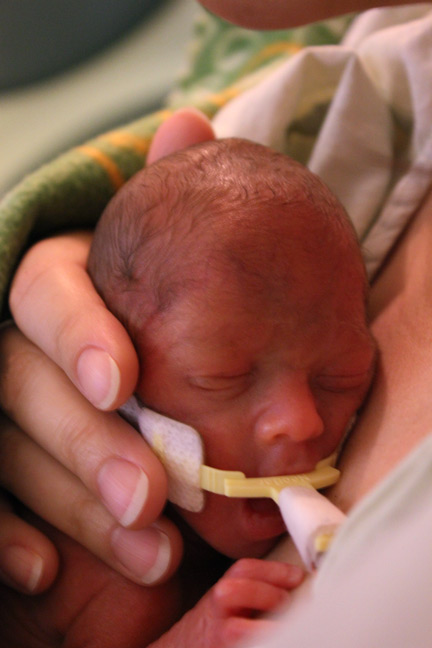
It’s holding your baby, skin to skin, on your bare chest with a blanket draped over your baby’s back to help keep him/her warm.
Benefits of Kangaroo Care for babies/parents?
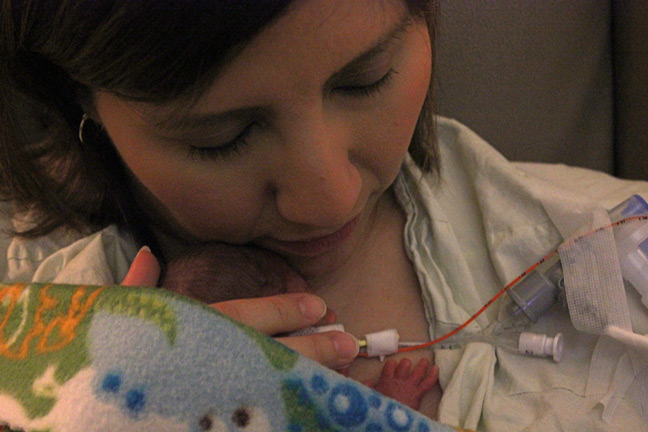
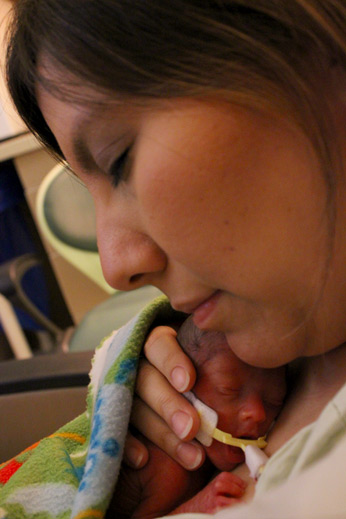
Julie and Grant snuggling during kangaroo care.
For the babies, holding 1 to 4 hours is highly recommended. Human touch is the foundation of infant development. It helps stabilize body temperature, stabilize heart/respiratory rates and oxygenation (decreases spells), enhances and facilitates breast feeding, enhances sleep/wake cycles, promotes longer deeper sleep, improves weight gain, enhances neurobrain development, enhances muscle growth, improves digestion, decreases pain and stress (less crying) and shortens hospital stay.
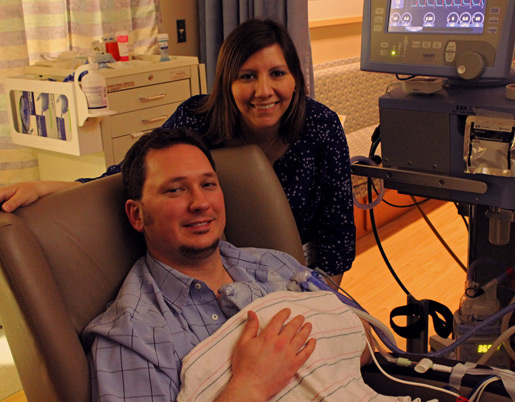
Grant and his proud parents!
For the parents, beneficial for breast feeding – increases milk let down, milk production and prolongs duration of breastfeeding. It encourages relaxation and decreases stress, enhances parent’s confidence and competence in caring for the babies, enhances parent/infant attachment and increases parent’s readiness at time of discharge from the NICU.
For both baby & parents, this is a good opportunity to learn each other’s cues, scents, voices, cries etc.
How is Kangaroo Care performed?
Kangaroo care begins. The nurses place Grant onto Julie’s chest.
I can’t just go and pick up Grant or Hazel and pick them up, there is a lot involved. First the nurse has to determine if our babies can tolerate Kangaroo Care. I was able to FINALLY hold my son, Grant for the 1st time at just 6 days old (gestational age 25 weeks). Let me tell you, holding him for the first time was amazing, wonderful, exciting, emotional and a tiny bit scary.
Vital signs, cares and assessments have to be done before you can hold skin-to-skin. With all of the lines and tubing it takes two nurses to transfer our baby to my chest. Once Grant was placed on my chest they position him in a flexed and tucked position and the nurses secure lines and tubing into place. They had me support Grant’s bottom and head and placed his hands near his mouth. Once we were both settled I was finally able to sit back and relax and just really take it all in and enjoy this amazing and wonderful time. Feeling Grant’s tiny hands and tiny fingers against my chest wiggling around and his tiny legs and tiny toes moving was the best feeling in the world! I thought, finally I am holding my little boy, something I thought at one point in time in the last five years I might never, ever feel. I could have sat their all night with him in my arms, it was so incredible. After the hour was up, the two nurses unsecured the lines and tubing and transferred Grant back into his isolette and put all the lines and tubing back into place and snuggled him back into bed.
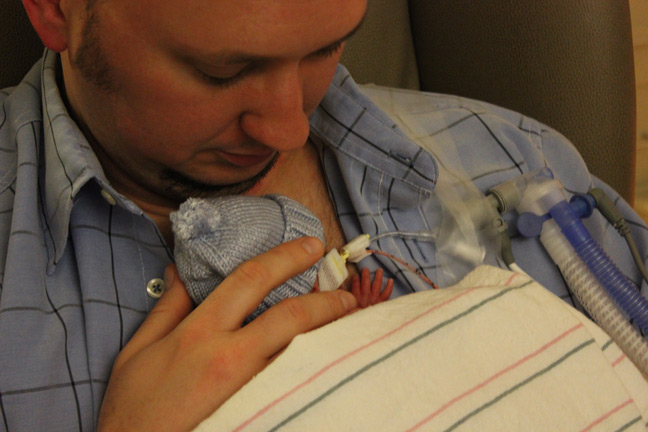
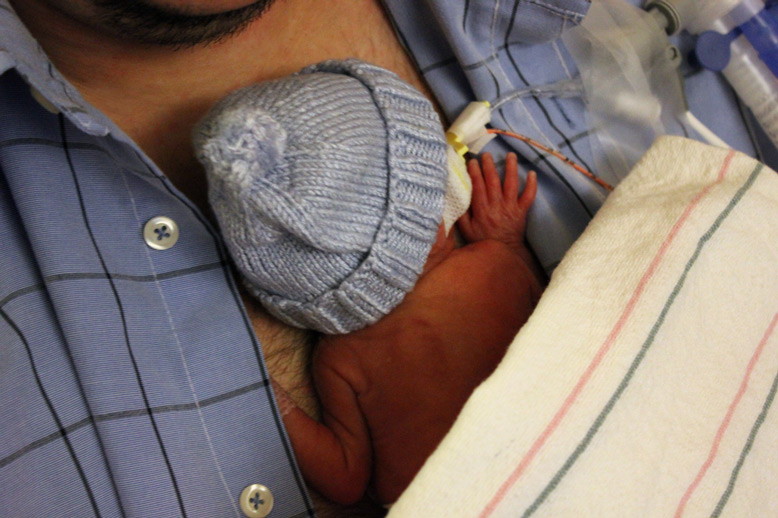
Daddy and Grant cuddling together.
The next day, Ryan got to do Kangaroo Care with Grant too. I think he was a bit more nervous than I was, but they did great together. I was so excited and happy for Ryan to be able to hold his son. This time with Grant was cherished and we had many tender moments together. Every baby has their own pace in the NICU, and Hazel has so far has not been stable enough to do Kangaroo Care, but we are hopeful the day will come soon. As they also have their ups and downs, we have only been able to do the Kangaroo Care with Grant just one time each. We are really looking forward to when they can both be held, but everything in good time and when they are ready for it.
I feel like I don’t know where to start with this post. Since our kids were born, I’ve lost all sense of time. Little things like getting a meal seem to take forever, and an hour in the NICU goes by in the blink of an eye. People are asking for updates, and I feel bad that we haven’t had time to post any updates through the blog. Here are the basics:
Hazel and Grant continue to fight for their lives daily. They were born at the edge of viability and the doctors have warned us that their stay in the NICU will be full of ups and downs. Bodily systems we normally take for granted are monitored daily for changes. Breathing, blood pressure, heart rate, hemoglobin, platelets, feeding, urine and stool are daily subjects for updates we get from the NICU team. We are learning a lot about the struggle typical of preemies and amazed at their fragility and endurance. We have both had the chance to hold Grant outside of the incubator, but Hazel has not yet been stable enough for this.
Infections are always a big concern. We wash our hands thoroughly and use hand sanitizer before we can touch or hold our babies. Even with all these precautions, it is not a completely sterile environment. The tubes and lines going into their bodies will need to be changed periodically, either because of risk of infection or an actual detected bacteria formation.
Ryan cuddling with Grant (25 weeks + 1 day)
For their privacy, I won’t go into details about particular daily challenges each faces on this blog. Everything is in constant flux, so by the time you read it, the situation may have changed. There may have been changes from the last NICU update by the time I write this. We will share more information in private conversation, but we’ll limit sharing with the internet.
Julie has been through a lot in the past week and a half. I continue to be amazed by her. She went in expecting a long stay in the hospital as we awaited the arrival of the triplets. She dreaded the loneliness, boredom and homesickness, but was willing to go through it for the kids. In less than a week, she started having contractions. At first she thought they were just the babies moving, but the monitors were detecting otherwise. Within about an hour of the first signs of contractions, they started to become painful for her and she was placed on magnesium sulfate, which is used primarily as neural protection for the babies in case they would be born but it can also have the effect of stalling contractions. Overnight the contractions continued, and we were moved from her antepartum care room to the labor and delivery area “as a precaution.”
The day’s contractions became increasingly painful, and Julie was given an epidural for the pain. She went through painful examinations of her cervix and ultrasounds. In the last ultrasound, the doctor had trouble seeing Baby A, and did a manual examination in which he discovered she was already starting to emerge. Julie was rushed into the operating room, where she delivered Marissa Jean vaginally. I saw Marissa’s hand move before she was quickly picked up by a nurse. We were in great suspense as the NICU team worked on Marissa in an adjacent room. At this time Julie was getting a cerclage (had her cervix stitched shut) to help keep the other two babies in and give them hope at a longer term in the womb. The NICU doctor returned to inform us that despite their best efforts, Marissa’s lungs were just not developed enough to get air into them. She was wrapped in a blanket and brought into us. We held her and sobbed. A doctor or nurse returned a few times to check her heartbeat until it could no longer be detected.
That night we were surrounded by close family as we mourned our loss. She was already missed as a daughter/granddaughter/niece.
Our hope turned to the other two babies, thinking that perhaps they would be able to make it in the womb for a couple more months. They still had their amniotic sacs, after all. The contractions were starting to subside, and Julie could now be on medication to prevent contractions and labor. In spite of all our hopes, the contractions returned. Julie was again moved to Labor and Delivery for closer monitoring.
This time, the contractions started placing increased stress on Baby B. Each contraction lowered the heart rate significantly, to the point that it was scary to watch the rate drop and the heartbeat would be barely audible through the monitor’s speaker. After a while of this, the doctors made the decision to do a c-section delivery of the other two babies.
Julie was prepped and wheeled away. I was told they would come get me in ten minutes. Ten minutes in hospital speak means “just keep waiting.” They finally led me into the operating room where it seemed the procedure was well under way. Julie had a spinal but was still extremely tense and uncomfortable. I can’t imagine what she was going through. Because of the surgical dressing, I couldn’t see anything, but I could hold the camera out enough to record the nurses who were ready to collect the babies as they were born.
“BIRTH!” they shouted out, followed by “thirty-six” – designating the time of birth. A baby flew by so quickly I couldn’t really see much. About 40 seconds later I heard the same declaration and time, followed by another baby being transported just as rapidly. I was left to simply comfort Julie as they proceeded to remove the three placentas, stitch her up and remove the cerclage stitches.
Someone placed bracelets on our wrists. I knew this was a good sign and reassured Julie, but she was still very stressed by everything she was going through at the moment.
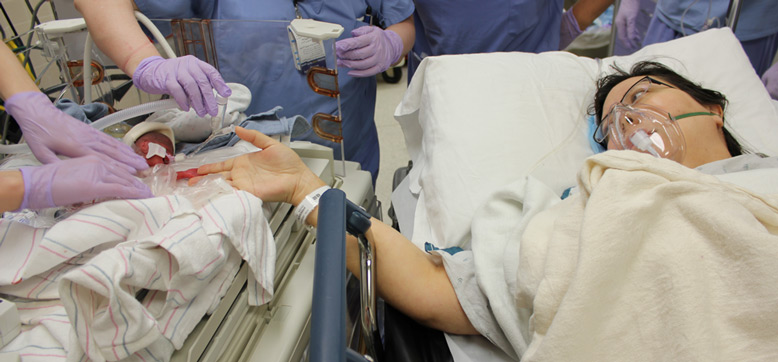
Julie meets Hazel for the first time.
The doctor came to get me and introduce me to my son, then to my daughter, neither of which yet had a name. Each were in their “Giraffe” beds and hooked up to breathing tubes and wrapped in plastic bags to retain heat. Our boy was carted away and Julie was wheeled into the room on her bed to meet our daughter. It was a very touching moment as she laid eyes on her for the first time and was able to hold her hand. I did my best to get both photos and video of the moment. Julie was then carted away to her room and I followed the NICU team to our kids’ room. I don’t even remember this trip, and I only know because I have the photos from when they first arrived in the room and can recall making the decision to go check on Julie at one point.
Julie was still extremely tense and agitated from everything. I think she found the will to overcome all the pain medications they administered, and I was there to witness everything she received. I did my best to calm her, talking her through breathing and positive imagery until she finally settled down. I then went back to Julie’s antepartum care room where immediate family was waiting so I could quickly share the news before going back to Julie.
After a while, Julie’s bed was rolled to the NICU so she could finally see Grant and see Hazel again. Then we returned to her antepartum room, completely wiped out. Over the last 76 hours, Julie had been in labor with contractions, received six IV pokes, got liters of drugs and fluid, delivered both vaginally and by c-section, received a cerclage, had a cerclage removed, named three kids and lost a daughter. She did all this with very little sleep. This was not the end, as she developed a fever, likely the result of an infection.
Julie was discharged on a Wednesday, and I had made plans to pick her up. We were both having such a difficult time in our grief. Julie was not ready to be separated from the kids, and I didn’t want to leave any of them there. I had already had difficulty being at work for only a day and a half that week. The hospital offered to let us stay in the room as it was not immediately needed, and we accepted the gracious offer. We finally went home that Saturday, after both kids had a “good” day in the NICU.
We are very thankful for everyone’s thoughts and prayers. Our entire family will need these for some time.
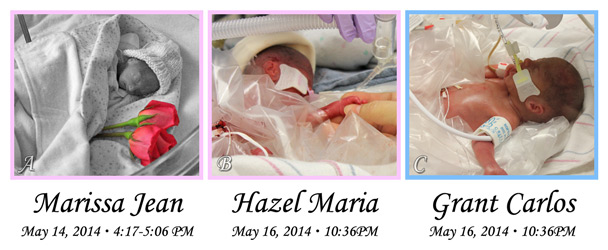
It has been a bittersweet week. We welcomed our three little ones into the world. On May 14 at 4:17PM, Marissa Jean (Baby A) was delivered vaginally. Because of the early membrane rupture, her lungs were not developed enough and despite the NICU staff attempts she could not be respirated. She passed at 5:06 pm in her parents’ arms, less than an hour after entering the world.
On Friday, May 16 at 10:36PM, Hazel Maria (Baby B) and Grant Carlos (Baby C) were delivered by C-section. Hazel was just a hair over a pound at birth. Grant was 1 pound 9 ounces at birth. Both responded well to interventions and are in the NICU. With a gestational age of 24 weeks and 1 day at birth, they have a long road ahead and will probably be in the hospital for another 4 months.
Julie is working to regain her strength after an extremely emotional and exhausting week. We appreciate your prayers and support in this time that is both joyful and sorrowful.
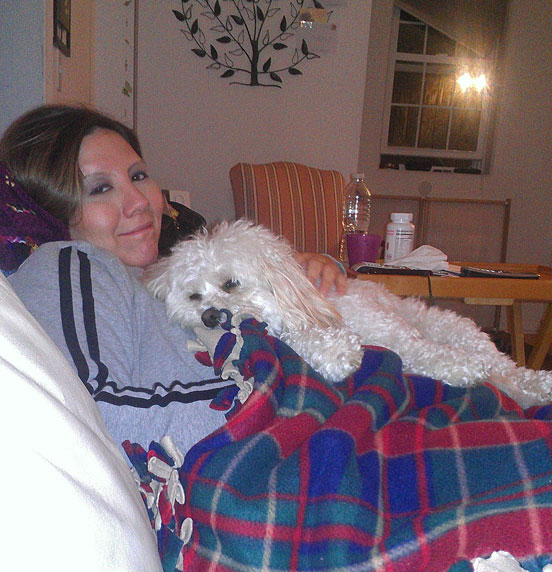
Being an expectant mother of triplets makes me so joyful. I’ve been wanting children for so long, struggled with infertility for nearly five years, and my dreams are finally being realized. But it is still so hard. Being in the hospital puts our minds at ease, knowing that the babies are being monitored twice daily and there are people who can help in an instant if it is needed. We are getting education as to what to expect if they are born within the next week or two and each week that I’m here benefits the babies – the longer I am here, the better. So far the care I have been receiving is wonderful – the doctors and nurses have been great. Although these things are all good, there are times its hard emotionally. I am missing family, my dog, and my home terribly. Doing what is best for the babies is what matters the most, but it doesn’t change the fact of what I face every day.
There is a time in my life I didn’t think I would be able to celebrate mother’s day from the perspective of being a mom, and this is the first time I will be able to do that. Even though the babies haven’t been born yet, I feel like the care that I’ve been giving them and the love I have for them defines motherhood. Even though I haven’t had the full experience raising babies/kids, I’ve already received mother’s day cards and flowers, making it official.
I have already had a few visitors, which really helps the time go by. I won’t publish my location on this blog, but if you would like to visit me, feel free to email, text or call me or Ryan and we’ll let you know where to find me. Some times of the day are busy with baby monitoring, doctors and meeting with other staff so it’s always good to arrange a visit ahead of time.
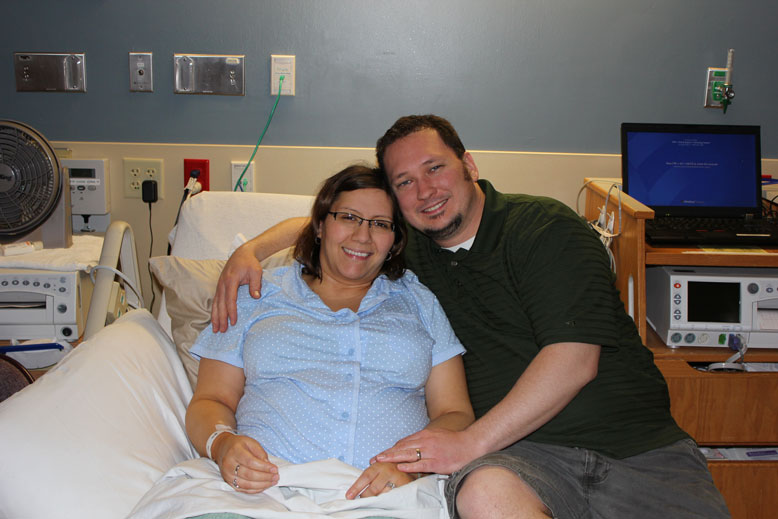
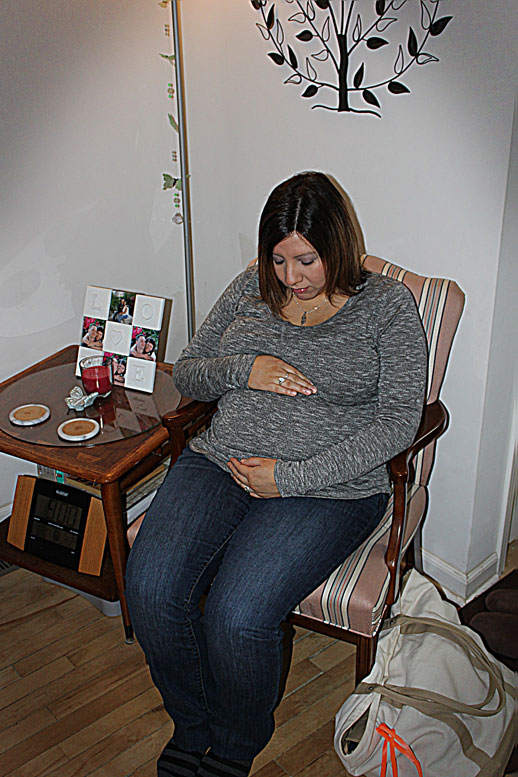
Julie ready to go to the hospital for monitored bed rest
Julie’s first day in the hospital was a little bittersweet. As we left home to check her in for monitored bed rest, she took one last look around the house, realizing that the next time she will be home is after the babies are born. When she returns, the house will be completely different. The basement project I have been working on should finally be done. Some furniture that is cramped in the living room will be moved into the space created downstairs. The furniture in our current bedroom will be completely moved out and a nursery, freshly painted and decorated, will be taking shape in preparation for the triplets’ arrival. When she comes back, she will be recovering from her c-section in a house that might seem strange compared to her hospital room where she will (hopefully) be for quite a while.
We left the house, not knowing exactly what to expect. As Tom Barnard read the news on the KQ morning show, I laughed at the funny parts, hoping Julie would join in. I could tell she was nervous and already a bit homesick.
Once we checked in, it was a complete whirlwind. As we filed into a tiny room, a nurse told us we would hopefully have a larger room around noon as it became available. Julie changed into the hospital garb and climbed into bed.
I shuffled my way into the corner, hoping to stay out of the nurse’s way as she whirred around, placing audio monitors onto Julie’s belly and adjusting them continuously as she sought the heartbeats of each baby. It’s still great reassurance to hear the strong and regular rhythm.
The hospital staff took blood, swabs, readings and observations. Everyone was great to work with and friendly, but there was a lot of poking and prodding. With the IV tap in, the magnesium sulfate treatment was started. This made Julie feel very hot and she started to get a bit nauseous to the point medication was needed to help with that. An ice pack provided a little comfort for her too.
We met with the nurse practitioner, doctor, and several nurses. I can’t remember who told us what, but the medications and treatments were explained. Some medications were used to prevent bleeding in the babies’ brains and relax the uterus, some were used to prevent infection, and some were used to help the babies’ lungs develop.
As everything was explained to us, one thing stuck in my head. Each day that Julie is in the hospital and pregnant reduces 9 days in the NICU (3 days per baby). That seems like such an incredible motivator, to think that each each week is worth 63 days less time the babies need to spend in the hospital! I knew Julie wasn’t looking forward to being stuck in the hospital for so long, but the sacrifice on her part would be worth it to help our kids when they are born.
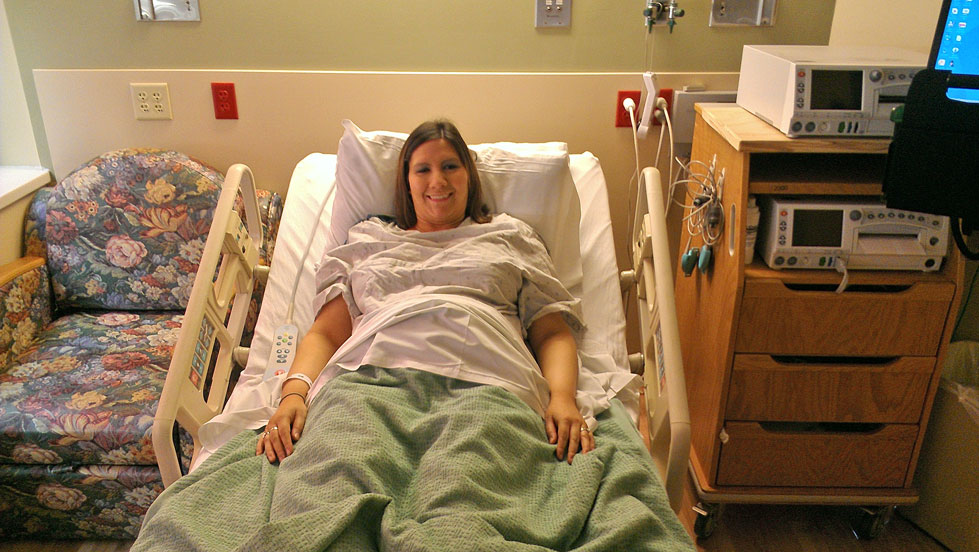
Julie shortly after checking in for monitored bed rest
As the day progressed, it was clear the larger room would not soon be available. I worked while Julie was occasionally monitored. After an extremely bland hospital food dinner, the bigger room was finally available! It was about 6:30 in the evening.
The “permanent” room is about twice as big. The view is not as nice, unless you like rooftop and brick wall views, but the space is worth it. I made trips back to the car for the rest of the belongings we packed for Julie’s stay. I believe it is about ¼ mile walk each time between the room and the car, so I probably got about a mile and half in that day.
The NICU doctor came in to our room and gave us a rundown of what to expect if our babies are born within the next two weeks. She told us how there would be a NICU team for each baby, about 8-10 people total just for our kids in addition to the other doctors and nurses in the room for the delivery. The babies would be immediately whisked away and we would be lucky to get a glimpse of them before they would be intubated, get a tube for feeding via their belly button and put into a Ziploc-like bag to preserve body heat. Without going into the details, I’ll say that at this point we would be most concerned about survival if they are born in the next couple weeks. Every couple weeks, the NICU doctor will give us an update what to expect, and each time the news becomes easier where, for example, the discussion is more about just needing a little oxygen instead of needing a breathing tube.
After the NICU doctor left, Julie had another round of monitoring the babies’ heartbeats. The little babies have so much room to squirm around, tracking them down can be challenging and time-consuming to verify an individual heartbeat to get simultaneous readings on all three. Just before the monitoring was over, Julie’s best friend arrived. I helped finalize all the arrangements Julie would need before I left to go back to the empty house.
I just had the “Level 2” full anatomy ultrasound this last week. Going into it, I was a bit nervous. More than anything, I wanted to know that all three were still thriving and had strong heartbeats. Baby A has had us so worried with the lack of amniotic fluid and leaking that recurs occasionally. Still, we were excited for another chance to see the babies.
We weren’t sure what to expect, and if we would have to wait through each measurement before learning the gender of each baby. They quickly went through the positioning and identification of each, and then they went on to the gender determination.
Ultrasound of Baby C at 21 weeks (Face)
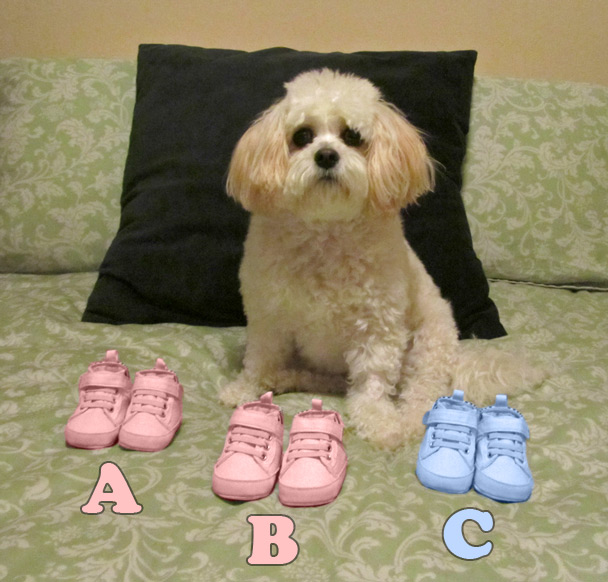
Baby C: This one has the “penthouse” and has been measuring larger than A & B. With the positioning, the nurse was fairly quickly able to identify. A boy! She marked down “….Blue: on the ultrasound and printed the image.
Ultrasound of Baby B at 21 weeks (Profile)
Baby B: In the middle, Baby B needed a little bit of nudging to move into positon, but again we were able to see. The nurse said, “and this one…” and continued to type on the ultrasound screen “…..PINK.” A girl!
No matter what our babies were going to be, all boys, all girls or a mix; we knew that we would be happy to grow our family. Still, we were hoping we would be able to experience raising both boy(s) and girl(s). We were so thrilled that our wish is coming true.
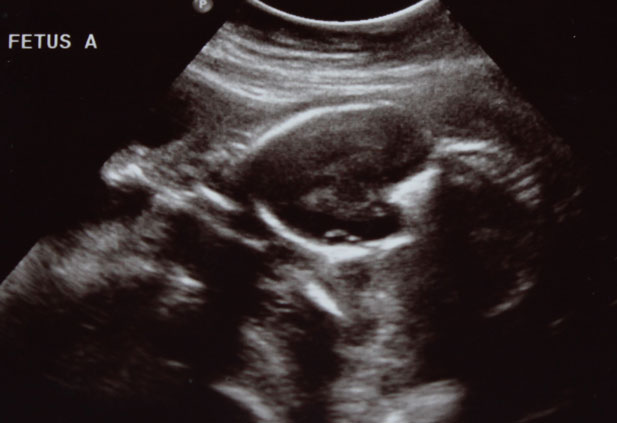
Ultrasound of Baby A at 21 weeks (pike position)
Baby A: Fluid creates dark areas in the ultrasound, which helps the nurses and doctors to see contrast against the babies. With the amniotic fluid drained to less than could be measured, there was little contrast. Making matters more difficult, Baby A was in the pike position (legs extended with head by the knees) and not in a good position to determine the gender. From this ultrasound we could not see anything.
We knew that at 17 weeks they were able to determine genders for all three, but had not told us, so we asked the nurse to check if anyone had made a note in our charts about this. When the nurse returned at the end of the ultrasound, she had a small piece of paper, which she unfolded to reveal the handwritten note: “Triplet A – probable girl.” A girl! Well, at least “probably.” We’re not sure what level of confidence there was at 17 weeks, so it is possible that is not 100% accurate. For the time being, that is the best information we have so we are going to say that we are expecting two girls and a boy!
The rest of the ultrasound was mostly routine. However, there is one piece of great news: when they looked at Baby C, they found his stomach is now ‘normal’ size! One less worry, and we are so thankful that he won’t face multiple corrective surgeries for the stomach. Our prayers have been answered!
The doctor came into the room to go over the results with us. She said she “is pleased.” Baby C measures in the 52nd percentile, Baby A in the 23rd percentile, and Baby B in the 15th percentile. She explained that triplets do not have a separate percentile scale from singletons, but a 52nd percentile triplet is actually pretty large. Regarding the smaller size of A and B, she said that they are less concerned about smaller babies, as long as their growth has been consistent and they are healthy. They look healthy and measurements are all basically in line with their past measurements and growth rates.
We asked about Baby B being smaller than Baby A, wondering if that was perhaps because she had the single umbilical artery (SUA). The doctor said blood flow looked good, but with B she was more concerned about the umbilical cord attachment at the placenta. The cord is attached to the periphery of the placenta, which has less blood distribution. This could be a concern, so it sounds like they will keep an eye on this as well. I guess we trade one concern for another at this point.
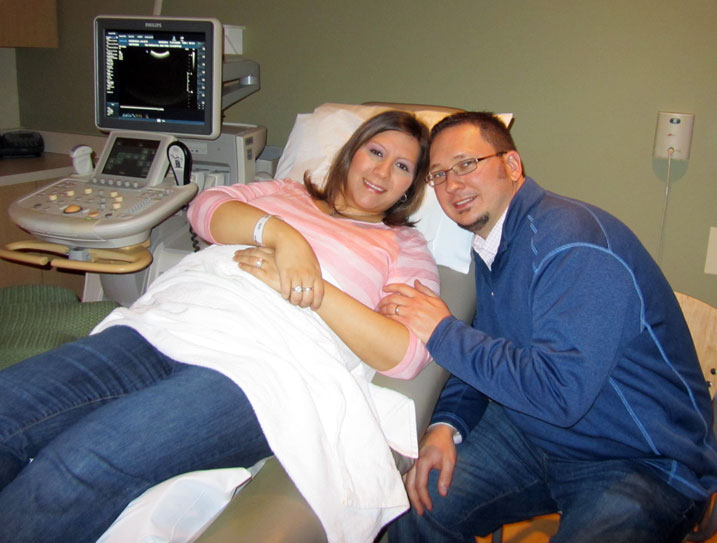
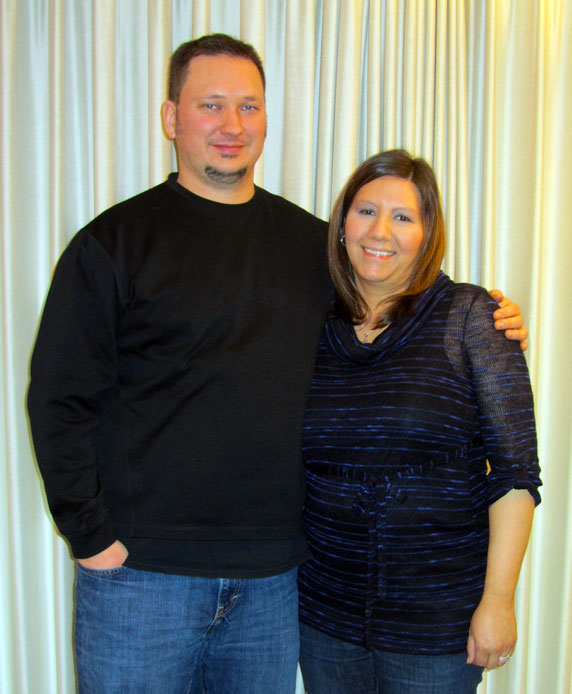
Parents (Julie and Ryan) at 21 week ultrasound
I expressed my concern about Baby A and the lack of amniotic fluid. The doctor told us how amniotic fluid is not needed for much, and the lung development happens at some unknown critical point between 16 and 22 weeks. Since there was still measurable fluid until about 19 weeks, the doctor is hopeful that the critical lung development occurred before then. Unfortunately, there is no way to know for sure until the “breathe” test when they are born. Once I am hospitalized, I will receive a steroid shot that will help all babies’ lungs develop. We remain concerned yet hopeful at this point.
Many times, Julie has felt the babies kicking. When I am around, she calls me over to try to feel it. I rush over, place my hands on her belly and… nothing. I always miss it.
Until today. Julie asked if my hands were full, and I noticed she had her own hands on her belly. I went over, hopeful as always but without high expectations. Then there were two taps! Another moment later, a much stronger kick. It was such an incredible experience for me. I had a big smile on my face, and it really made my day. After all the recent worries about the babies and Julie being placed on bed rest, this was a happy moment that we both needed.
Well, I went back to the clinic to follow up on my progress, see if Baby A had regained amniotic fluid and if there would be any chance of coming off bed rest. The good news is, all babies have good strong heartbeats and good umbilical blood flow. Unfortunately, Baby A still has so little amniotic fluid that they weren’t even able to measure it.
The doctor says the membrane must be ruptured, even though it is still there and largely in tact. I need to be very careful of signs of infection and avoid sick people. I am on bed rest for the remainder of the pregnancy, and at 24 weeks I will be hospitalized. At that time they will give me antibiotics by IV for a couple days and steroids to help Baby A’s lung development. In the meantime, I’ll need weekly doctor visits to continue monitoring the babies.
I was really disappointed at this news. I was just hoping so badly that I would see the fluid regenerated and things would look better for the babies.
We wanted to take a moment to publicly thank everyone for all the support we have received. Those who have called, stopped by to visit, helped with chores, brought us groceries or meals, sent us mail and supported us in other ways have been a huge blessing. The calls and visits with Julie really help the time pass and make the bed rest much less lonely.